
On the morning before junior Amaya Tawasha Diwan is scheduled to speak at the Second Annual People’s Conference for Palestine, she Googles her name out of curiosity, wondering if the conference will be mentioned. Instead, she finds an X thread in which strangers, who refer to her by her full name and mention her location in the Bay Area, accuse her of “pushing extremism” and “betraying Western ideals”. Seeing that the post has received almost a thousand comments from strangers, Diwan feels alarmed, but her fear doesn’t shake her resolve to continue speaking out for Palestine. Like other Lowell students who have found a passion in activism, Diwan is willing to fight tirelessly to make her voice heard.
While activism and movements pushing for change have always existed in society, recent times have brought on a resurgence of conversations revolving around issues both domestic and foreign. This year, many of these protests have taken place in San Francisco, including movements protesting ICE activity nationwide, condemning the Palestinian genocide, and most recently related to the SFUSD teacher’s strike, and feature significant participation from young people. Whether it is through advocacy regarding current issues, encouraging civic participation or raising awareness around concerns of local politics, many Lowell students have found ways to make their voices heard.
In a recent survey conducted by The Lowell in March of 2026, 119 of 130 respondents (91.5 percent) indicated that they believe it is important for students to engage in activism. Civic engagement and activism provide ways for students to affect social change, appealing to the common desire to have an impact outside of oneself. Dr. Constance Flanagan is an author and professor in the School of Human Ecology at the University of Wisconsin-Madison, who focuses on youth and community actions for the common good. She commented on the place that activism can hold for young people who are exploring their role within society. “[For most] high school students, taking a stand on something is the first act [of civic engagement] that they’ve ever done,” Dr. Flanagan said. “Realizing that they have an opinion or that anybody might listen to it is pretty important.”
While activism might provide a similar appeal to all young people, student activists engage in their work for a variety of reasons. Some, including Diwan, are spurred to action because of the injustice they observe in the world around them. “Most of what inspires me to be involved in activism is how much suffering I see other people going through, knowing that it could be prevented if people were to take action,” Diwan said. This motivation has led her to become deeply involved in activism, which she does in part through Lowell’s Middle Eastern and North African club (MENA). “I was a part of organizing two walkouts in my freshman year, and then this year I co-organized the walkout for Palestine,” she said. She received the invitation to participate in the People’s Conference for Palestine in Detroit in August 2025, where she was able to share her work and personal experiences on a student panel. Diwan also describes maintaining her advocacy in her day-to-day life. “In my classes, whenever I can bring Palestine into the conversation, I will,” she said. “[I] just try [to] draw those parallels [through] essays, presentations… even just conversations and class discussions.”
For others, the call to action comes from personal circumstances. Senior Winnie Liao, who currently works in advocacy on the topic of housing insecurity, was first exposed to the issue in her own life. “I got really involved when I had a specific incident with housing security and instability,” Liao shared. “Because of that situation and the lack of English proficiency in my family, I had to step up and use my own skills and abilities to seek out legal counseling.” Liao’s personal experiences raised her awareness about similar challenges faced by other members of her community, motivating her to get involved in local politics. “I went and volunteered with the Housing Rights Committee to not only volunteer and connect tenants with housing counselors, but also read through tenants’ rights and laws myself to protect my own family,” Liao said. “That was sort of the catalyst, and afterwards I got more involved with the San Francisco Youth Commission and doing a lot of legislative advocacy and activism.” 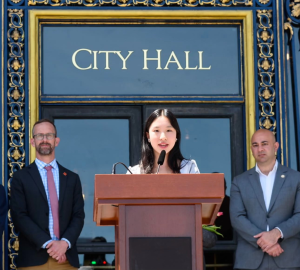
Senior Emily Gorodetskiy recalls getting involved with advocacy due to what she viewed as a lack of interest and understanding in her community about important issues, which manifested as a low degree of political engagement, particularly for young people who are newly eligible to vote. “We need to be electing people that truly represent our values, and youth can’t do that if they’re not going out to vote,” she said. Gorodetskiy described a recent project that she undertook with the goal of boosting civic engagement and voting in underrepresented communities, in which she blended her passion for giving back to the community with her interest in virtual reality technology. She designed a VR experience simulating the environment of a polling place, which involved instructions and guidance translated into multiple languages. She hopes that the simulation will help people feel more comfortable with the process, which will in turn make them more likely to go out to vote. Gorodetskiy explained that she was able to bring the VR headset to community events, where she got the opportunity to interact with community members and ask them questions about their experiences. “Not only did that help me learn more about my community, but it also helped me understand what [our] community needs are,” she said.
Political and social movements in the U.S. throughout history have frequently featured the involvement of youth, with student actions on college campuses often defining peoples’ memories of famous protests. Experts propose potential ideas to explain the appeal of activism for young people. Dr. Laura Harrison is the chair of the Department of Counseling and Higher Education at Ohio University. She has previously served as the Associate Dean of Students at Stanford University and taught courses on leadership at the University of San Francisco. She offered a potential explanation for why students tend to get involved in activism more often than older demographics. “It’s sad to say, but a lot of adults and older people quit learning and being engaged with the world,” Dr. Harrison said. “Young people are fiery and they tend to be more emotionally expressive, even sometimes self-righteous. But you need that in any society…older people who are more restrained about things, [and] young people who are fiery. I think those tensions are really good for society.”
Dr. Flanagan also commented on the reasons why many students gravitate towards activism and push for social change. “Younger generations, on average, are much more open-minded and tolerant than older generations,” she said. “[Young people] have grown up with a much more diverse experience on all kinds of things, and therefore see things from a more heterogeneous point of view.” Dr. Flanagan notes that new issues and challenges are emerging with developments in the current political climate, and to deal with these changes, new methods and needs arise. With conflicting ideas come discussions, and those discussions spark necessary change.
Students are often discouraged from participating in activism because of the common sentiment that individual efforts are meaningless because they are not likely to create tangible social or political change. However, youth have been able to make successful waves through activism and push for change throughout history. Dr. Flanagan mentioned the crucial role youth have played in recent social and political movements, such as #MeToo, Black Lives Matter, and activism in the climate crisis. Liao echoed these ideas, reiterating that students have more power to impact the society around them than they may think. “No matter who you are, you can still create change,” she said. “I was really helping my family out…even though I felt that I was just a teenager and that I had no real power.” Junior Cecelia Mills agreed with the idea that young people can have profound impacts on the social movements they participate in. “The way that young people and students interact with the world and interact with politics can really be instrumental in shaping the outcomes of activism and of social justice issues,” she said. “I think that the voices of young people and of students are a really powerful tool, especially since a lot of us can’t vote yet, so we have to make our voices heard through activism.”
With the current state of social and political turmoil in America, staying educated on current events is the first step towards impacting positive change. In The Lowell‘s survey, 111 of 130 students (85.4 percent) believe that students have a responsibility to stay informed on current social and political issues. “I think [students’] responsibility is to be educated enough to the point that [they] can form an informed opinion on it,” Liao said. “It’s your duty to use your lived experiences and perspectives to form your own opinion about it.” Mills agreed with this idea, stating, “I think we do have a certain level of responsibility to be aware of what’s going on in the world, especially if we are going to be speaking about any sort of issue… I think it is also sort of our duty as young people to get involved in these things and to fight for a better world.”
But despite the importance of political engagement, it can be difficult for youth to participate in activism for a multitude of reasons. 59 of 130 respondents to The Lowell‘s survey (45.4 percent) indicated they have faced barriers to participating in activism. Some students are scared of the authorities or their parent’s disapproval, while others feel like they don’t have time to participate, or worry that their actions won’t make any difference. Liao acknowledges that some people are unable to participate in activism by organizing or attending protests. “If you’re facing barriers to activism, that’s not something that you can control,” she said. “I would say to completely prioritize your safety and your health.” Still, she encourages people to stay informed on important events and issues. “Just being aware of the issue, why you feel that way about the issue, and if you wanted to take action, what you could do is your responsibility at the minimum,” Liao said.
Others bring up alternatives to the common understanding of activism as physically protesting in the form of walkouts or demonstrations. While this is an integral part of activism, there are other ways to participate that are less commonly discussed. Gorodetskiy mentioned how being involved can come in ways people don’t tend to think about. “Maybe [it] looks like hosting a workshop or doing interviews with people in a certain district and talking to them about their experiences,” she said. Gorodetskiy believes in the importance of student civic engagement, and notes that opportunities for participating in the civic process are not often utilized due to a lack of interest or awareness. She encourages students to attend meetings that provide opportunities for public comment, such as city boards and the Board of Supervisors and Board of Education, if they have concerns. Some activists, like Diwan, believe that social media can also be used as a positive tool to raise awareness and influence others to get involved. “Most of us have Instagram, meaning we have a platform,” she said. “Even if you only have like 10 friends that you follow that follow you back, that’s still 10 people that you could be educating and outreaching to.”

Many social movements overlap in their concerns and motivations, creating opportunities for activists to uplift one another. “So many of the [social] and political issues that we’re facing in our country right now are linked,” Mills said. She describes herself as primarily participating in anti-Trump movements, including “anti-ICE, pro-LGBTQ rights, pro-women’s rights, and pro-Palestine [rights].” Students who support one cause often find themselves working with other causes to make a greater impact. Liao said that she often tries to collaborate with other “youth voices in the city.” She described a recent instance in which she attended a youth transit round table involving a group affiliated with SFMTA and several youth councils from different city districts, which was a positive experience. “I think fostering spaces where a lot of people can come together and discuss issues that they’re concerned about is [important]… because we’re stronger together,” she said. Dr. Flanagan spoke on the importance of collaboration in activism, stating that, “the real shift in political awareness is when you realize that your problems are not just your problems, [they are] structural problems.” She describes being politically aware as “when you can link your capacities to have an opinion on stuff that matters to you to what other people are also experiencing, and you [realize that] we could work together to make some change.” This connection and evolving understanding between interconnected causes is vital to keeping movements in motion.
Being an activist can sometimes mean facing scrutiny and criticism, which can come in the form of bullying and harassment. Diwan described one such instance, sharing, “Someone made an aggressive comment about us, saying if I went to this school, these kids would have to run and hide, which was scary for a 14 year old… we just had to deal with that.” Threats of violence, direct or implied, are a common, yet incredibly serious and troubling, experience for students who are publicly involved in activism. But despite the intimidation from comments such as this one, Diwan isn’t planning on giving up her advocacy work. “It’s scary to think that protesting the genocide of my people could get me blacklisted, but I’d do it again because I’m not going to just sit here and be quiet when people are getting slaughtered,” she said.
While facing harassment can be intimidating and alarming, student activists sometimes face the opposite issue: not being taken seriously. Liao shared an experience of facing dismissal when she approached a district supervisor with a request to create a youth council for the district. She felt that the district supervisor she spoke to shut down her request without listening to her or offering any alternative support. Despite these obstacles, Liao said she and the other students who wanted to be involved on the council ultimately found success through collaborations with local community organizations and the team’s persistence, and encourages others to not be discouraged by rejection. “There are people in the community who have your same views and will support you,” Liao said. “There’s always a way for you to get what you want done.” Mills shared an experience of organizing a demonstration during the recent teachers’ strike, in which the students’ attempt to meet with Superintendent Maria Su was denied when she sent a representative instead. Despite this refusal, Mills described the strike as still being impactful because of the turnout and conversations that the event sparked. “It was still an important action,” they said.
Engaging in advocacy work, and even staying informed about current events, can inevitably take a mental toll due to the proximity to serious and heavy content. Students can be especially vulnerable to this effect due to their impressionable states of mental well-being. But Dr. Harrison’s work has led her to the idea that activism can be personally beneficial as it allows students to cope with the overwhelming nature of injustice and tragedy by providing a way for them to have an external impact. “[Student activists seem] connected and full of purpose and energetic at a time when we’re really worried about mental health issues among young people,” Dr. Harrison said. “They seemed happy to me, they seemed to be thriving in a psychological sense, whereas I think the doom scrolling and the non-participation…actually has more psychological harm,” she said. “That’s when people have heightened anxiety and don’t have an outlet for all those strong feelings and values.”
Student activists share the conviction that participating in activism can be deeply rewarding, and draw inspiration from demonstrations of hope and resilience that come from communities experiencing the deepest hardships. Diwan described her pride for Palestinian people and the immense respect she has for their perseverance through tragedy. “[I see] their resilience through suffering,” she said. “[They might be] starving families, but they still smile and they’re incredibly grateful for what they have. They still dance, they still sing. They’re still trying to live while existing in inhumane circumstances.” Diwan draws the strength to keep fighting for better conditions when she sees demonstrations of joy like this. “That keeps me going,” she said.
At the end of the day, individual students may not have the power to change systems of oppression single-handedly, but they do hold the power to be involved in the solution. “You can complain all you want, but nothing is going to change unless you actually do something,” Diwan said.