

Sam, a senior under a pseudonym, watched in hesitation as her father pulled into the driveway. The side mirror on his car was broken, and the scent of alcohol was heavy on his breath. Sam knew he was drunk. Again. When Sam attempted to confront him he shook off her accusation and got back in the car. Sam watched her dad disappear in the distance, tears spilling down her face.
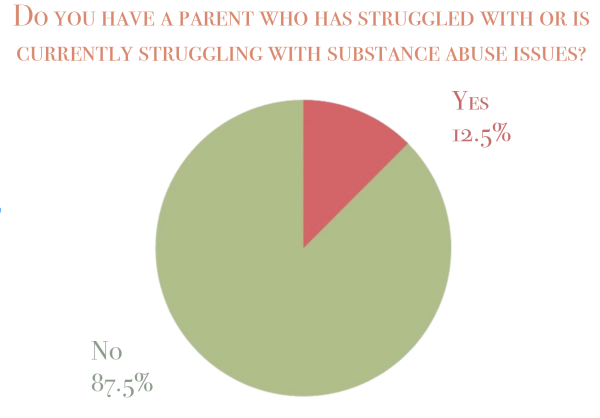
Sam is not the only Lowell student whose life has been impacted by a parent abusing substances. In a Jan. 2026 survey conducted by The Lowell of 112 students, 13 percent reported that they have had a parent who struggled with substance abuse. Additionally, according to a survey conducted by the National Institute of Health (NIH), 19 million adolescents in the U.S. under the age of 18 lived among a parent with substance use disorder in 2023 – that’s one in four children. Parental substance abuse causes significant educational, relational, and psychological issues to the adolescents under their care.
According to the World Health Organization, substance abuse is defined as “the harmful or dangerous use of drugs like alcohol, marijuana, psychoactive compounds, and other illicit drugs.” Parents with substance abuse can use the drugs inappropriately or with disregard to how using might make their family feel. Parental substance use disorder is extremely common and is an issue that affects all kinds of families regardless of culture, class, or gender. Dr. Shevi Loewinger, a licensed family and couples therapist, attested to the prevalence of substance abuse. “I see this phenomenon affecting a lot of families, couples, and individuals,” she said. “It’s all over the spectrum of families.”
Guardians are the most influential figures in a child’s life. But, according to Dr. Loewinger, a guardian doesn’t have the capacity to be a good role model when consumed by their addiction. “The kid is in a developmental stage, [where] the adults should be calm and self-regulated,” Loewinger stated. When the parent or parents of a young child face addiction, they are often less responsive to their child’s needs and emotional wellbeing. “Parents who are busy with their addiction [aren’t] teaching their kids self-regulating, understanding, acceptance, and compassion,” she said. Younger children may be unaware of their parent’s condition because they lack the knowledge to properly identify the problem. In a survey by The Lowell in Jan. of 2026, around 54 percent of respondents’ parents’ substance abuse disorders occurred when the respondent was under six years old. Additionally, around 35 percent of student respondents reported parental substance use issues when they were within the ages of six to ten years old.

Especially at younger ages, growing up around a parent who frequently uses drugs or alcohol creates a new normal in a child’s life. When a child grows up in an environment where parental substance abuse is integrated into their daily routine, it can be difficult for them to recognize their irregular home life. Sarah, a junior under a pseudonym, recalls little things about her home that reminded her of her father’s addiction: “Our bathroom didn’t have windows, so it would always smell like something. I thought it was just a ‘bathroom smell,’” she said. It wasn’t until years later that Sarah discovered her father’s frequent use of marijuana and tobacco. “Every time I smell that smell, it brings me back,” she remarked.
An adult deep in addiction can be an unreliable guardian for their children and put them at risk for developing long lasting mental health issues. Philemina, a senior under a pseudonym, recalled that her father’s substance abuse affected the mental health of her brother and launched him into a prolonged period of isolation. “My brother was just really quiet and kept to himself,” she said. As her brother grew older and began to understand more about their father’s addiction, he grew out of his isolation. Philemina and Sam reflected that their respective fathers often distanced themselves from others because of their addictions. Whether it was intentional or not, it was clear that his substance abuse was creating distance between him and his loved ones. “It puts a rift between you and your other relationships,” she said. “When you’re inebriated…it means less to other people if you’re being kind to them.” Drug abuse can also cause the user to create distance between themself and the rest of their family, especially when their addiction goes beyond recreational use.
Along with family life, parental substance abuse that leads to absence – whether emotional or physical – can have negative side effects on their child’s education. In a survey by The Lowell in Jan. 2026, 78 percent of those who felt that parental substance abuse affected their academic life reported that they had lower levels of motivation, due to their parent’s substance abuse. Additionally, despite having close friends or a supportive community at Lowell, it can still feel hostile for those with a rocky home life to feel understood at school. As Sam’s father’s addiction worsened, he went to a rehabilitation center. Without the presence of her father, who was the primary parent that held her accountable for her grades, Sam began to skip classes and arrive at school late, causing her grades to slip. When well-meaning teachers confronted Sam about her grades, she felt like she couldn’t tell them the truth, which only perpetuated the cycle of cutting class. “[They didn’t] understand what I was going through,” she said, “I just felt really unseen and unmotivated.”
A study done in 2022 by Dr. Emily Lowthian, titled “Parental Substance Use on Children’s Educational Outcomes: A Review” found that there was “a negative association between a parent’s substance use and their children’s educational attainment.” The study also revealed that not only was parental substance abuse creating issues with truancy and suspensions in their children, but also that parental substance abuse was linked with lower academic self-esteem. These issues can make feelings of isolation and inadequacy more prominent, especially at academically rigorous schools like Lowell.
Similarly, Mae, a senior under a pseudonym, said that talking about her home life at school feels uncomfortable. She mentioned that most of her peers rarely talk about their parents to begin with, but her familial problems can make her feel disconnected from her friends if the subject comes up. “I feel like I have a hard time connecting with people on that front,” she said. Similarly, Sam found that being around her friends whose parents don’t deal with substance abuse makes it harder for her to open up about her own home life, in fear of burdening her friends. “I feel really envious of my friends and their families,” she said.
Growing up with a parent on drugs or alcohol can change the way their child views these substances. For some, witnessing how drugs impact their parent or guardians can lead to apprehension and an aversion to drugs in general. It’s not uncommon for drugs and alcohol to be introduced to adolescents during their teenage years. For those with an aversion to substances because of their parents, social settings where they’re present might feel uncomfortable. Mae testified to these experiences, saying how growing up near substances has made her feel standoffish and sometimes disapproving around her peers who use. “I try not to be [judgmental], but it’s hard not to be when I see such dramatic negative impacts of [alcohol],” Mae said. Similarly, Sarah shared this view, explaining that even the thought of tobacco disgusts her after her grandmother’s death due to lung cancer and her father’s high blood pressure caused by smoking. “Smoking in general just feels really grimy; I don’t like the idea of it,” Sarah said.
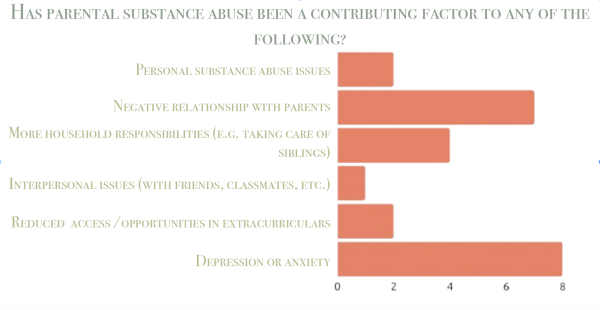
On the other hand, children of parents with substance abuse disorders are, according to the American Academy of Experts in Traumatic Stress, three to four times more likely to develop these disorders themselves. Growing up in a household with parental substance abuse also comes with a higher risk of depression, eating disorders, and other maladaptive behaviors. Dr. Loewinger also pointed out the likelihood of substance abuse coming from an addicted parent or parents. “It’s starting from people who were raised by addicted parents… almost every patient that I’m having has some alcoholism in the family.” A study from the National Institute of Health in 2019 going over the risks of parental substance use found that around 45% of adolescents with a family history of substance use disorders grew up to also have substance use issues themselves. Sam stated that she turned to marijuana to cope with the stress of her dad’s addiction. However, while she said that she does abuse marijuana, she also sees it as an opportunity to connect with her peers that are also enjoying the drug, contrasting her dad’s use of drugs alone.
Addiction can also cause monetary issues, leading to interpersonal conflicts with the family’s providers and the dependents. According to the American Addiction Center, the abuse of alcohol or drugs can cause significant financial stress, sometimes leading to bankruptcy, poverty, and an overall burden on the user’s entire family. For both Sam and Mae, their father’s alcoholism has had detrimental impacts on their families finances, leading both of their families to have to move. Sam’s father had to sell their house because of financial troubles as a result of drinking and paying for rehab, which was extremely expensive. Additionally, Sam now has to commute to her dads house, which is out of the city. “I really, really wish he didn’t sell our house,” Sam said. “That’s a big stress on me today.”
Similarly, Mae’s father’s alcoholism contributed to a series of poor financial decisions which forced her family to move into a smaller home, causing additional strain on her family. Furthermore, her father was not able to contribute financially to her college education due to his unemployment. Despite her fathers absence, he still boasts about his daughter’s accomplishments, which makes Mae feel frustrated. “He’s kind of taking credit for something he can’t contribute to,” she said.
The disconnect between a parent’s relationship with their children can also extend to romantic partners, causing strained relations and in some cases, can lead to divorce. According to a 2014 study called Reasons for Divorce and Recollections of Premarital Intervention, substance abuse was cited as the reason for divorce 35% of the time. Sarah said that her parent’s divorce was complicated. Her mom, who always made a clear effort to stay away from drugs, was constantly manipulated by her dad. Sarah said that he’d had a rough childhood that led to his addiction and behavioral problems later in life. Sarah explained that, for a number of reasons including his drug use, her mom wanted to end the relationship. “[My mom would] just try to get away from the situation, but obviously when you’re married to someone and you have three kids you can’t do that,” Sarah said. Eventually, they did separate, but their split was aggressive, and had lasting impacts on everyone in Sarah’s family.
Even if the parents don’t end up divorcing, the substance use of one parent can cause unreliability or disconnect between the partners. Philemina explained that her mom was probably affected the most by her father’s addiction. “She’s missing a partner in the real sense, in the home,” she said. Philemina stated that her fathers cycle of stress and then drugs to cope with his stress put a wall between him and his family. “[He] just doesn’t have the bandwidth to help in the house or be a part of his family,” she explained.
A study conducted in 2014 by Dr. Jane Anderson showed that “divorce… diminish[es] a child’s future competence in all areas of life, including family relationships, education, emotional well-being, and future earning power.” The younger a child is when they experience their parents divorce, the more these effects are amplified, causing a greater risk of economically and emotionally unstable childhoods. At the same time, the divorce affects the child’s relationship with their guardians, potentially creating a rift between them.
Persistent substance abuse can cause adverse health effects, no matter what substance someone is reliant on. The National Institute of Health reported that alcoholism occurs in nearly 40 percent of parents with a substance use disorder, making it the most common form of parental substance abuse. Additionally, the NIH found that frequent and prolonged drinking can cause liver failure, contribute to mental health issues, and even increase the risk of cancer. Seeing a parent go through an array of health problems caused by continual substance use can arouse complicated feelings of worry and frustration: “It feels like they’re picking this stupid thing over their own child,” Sam said.
Up to 75 percent of addicts recover, according to Focused Addiction Recovery. Behavioral therapy and rehab are common ways for those with an addiction to recover, but the most difficult part of recovery is making it last. When someone uses drugs frequently, they can develop a physical dependence that alters the chemical composition of their body and sends intense withdrawal symptoms to their brain whenever the drug isn’t used. This dependence can make quitting extremely difficult. Philemina’s dad often quits smoking only to start again months later. “It’s definitely an ebb and flow. He probably experiences shame at some point and then pulls back and then maybe he’ll be like, okay, I’m dry off this thing. Let me try a new [drug],” Philemina said. The inconsistent status of his recovery can make Philemina’s father’s commitment to it feel unreliable.
Recovery, even if it’s achieved, doesn’t always erase the damage caused by substance abuse disorder. Sam’s dad has been sober ever since rehab, she still feels disconnected from him as if nothing’s changed. “I was really disappointed when he came out of rehab,” she said. I thought he would be, like, a less angry person overall. That wasn’t really true.” Although she’s glad he recovered, calling him on a pay phone while he was in a rehab center and simultaneously dealing with her own mental health issues has made the experience especially difficult.
Balancing the complex nature and facets of maturing while a parent is under the influence of substances is extremely difficult for adolescents. Whether or not a parent continues to use a substance is on the parent– not the child. “I don’t think people can change if they don’t want to change,” Sam said. Oftentimes, the most that a child can do to improve their situation is to focus on what they do have control over changing. “Go to therapy, pick up a hobby, and honestly, leave it alone and don’t try to help them,” said Philemina, “Protect your peace.”