
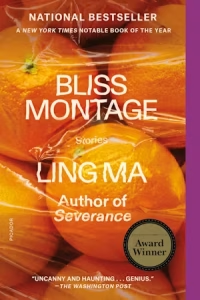
What is a bliss montage? Countless modern films contain examples of these sequences: the flawless patchwork of joy and harmony, a moment in paradise just before it is violently ripped away by the cruel hands of fate. This idea, however, is not the premise of Ling Ma’s 2022 novel Bliss Montage – at least, not the whole premise. Instead, Ma’s collection of short stories blends pleasure with despair, featuring undercurrents of darkness between a vibrant collage of scenes. The surreality and fantastical elements permeating Ma’s stories do little to alleviate the creeping discomfort that lurks under the surface – rather, these details enhance this growing sensation. In a story titled “Yeti Lovemaking”, the main character’s sexual exploits with the titular cryptid are overshadowed by the ultimate message of loneliness and regret after the end of a long-term relationship. Another story titled simply “G” after the name of a drug that renders its users invisible contains a deeper message: one of jealousy, body image struggles, internalized xenophobia, and toxic friendship. The elements of fantasy seem to introduce levity to these stories, but the superficial distractions inevitably warp and crack in the blistering face of a harsh reality. Ma’s collection tells many versions of the same story: one where beautiful things decompose and synthetic perfection does little to disguise the grotesque truth of a reality that is far from perfect.
Surreal settings characterize Ma’s work in Bliss Montage, but unlike other fantastical works, her stories never fail to appear grounded. The inevitably strange and inexplicable elements that appear over and over again in Bliss Montage ultimately enhance the feeling of reality imbued in the stories, providing brilliant and surprising symbolism that conveys meaning beyond the obvious. Through rich sensory descriptions of everything from spaghetti and a leather sofa to Yeti fur and the sensation of becoming invisible, Ma immerses her reader in stories whose absurd nature would typically risk distancing the audience from their subject material. In Ma’s very first story of the collection, “Los Angeles”, the opening pages are packed with bizarre exposition: a woman lives in an LA mansion with all 100 of her ex-boyfriends, and a husband whose dialogue is expressed on the page simply as a string of dollar signs. Under the surface, however, the true story lies in memories of her past, including those of an abusive relationship that she can’t seem to escape. In this manner, Ma shows how even in fantastical realities, meaning can be found in the human stories at their heart, both the beautiful and the ugly.
The individual stories in Bliss Montage, which would otherwise seem disjointed or unnatural together, are strung together by similar thematic elements. Ma’s characters often share characteristics with herself, hinting at the self-examination taking place in her work; many of her stories are narrated in the first person by Chinese-American women, with personal details like names rarely directly stated and only revealed through dialogue, and include nuanced depictions of ideas like female bodily autonomy and the feelings of alienation arising from conflicting cultural backgrounds. Themes like generational trauma, emotional turmoil, and abusive relationships, whether platonic, romantic and familial, are repeated in otherwise vastly different stories, weaving them into a dreamlike sequence that appears to take place in alternate versions of the same universe. The resulting effect is that of a montage, as the title alludes, but not exactly a blissful one: together, the stories appear to contain raw pieces of a complex reality, rendered unrecognizable in a strange daydream. It’s difficult to finish Bliss Montage feeling satisfied, as the characters rarely reach any kind of resolution or peace from the central conflicts by the conclusion of their stories; instead, the reader is left with the certainty, comforting or otherwise, that the character’s haunted lives will remain relatively unchanged. Rarely is a character freed from Ma’s hallucinatory dreamscape – they are forever doomed to contend with the strife of a subdued yet tumultuous reality.
Bliss Montage is not a long book, but its unique blend of magical realism, deeply introspective tone and unflinching social commentary will stay with readers long after the last page. The book strikes a rare balance between lighthearted absurdity and painful tragedy, all tied together with absolutely brilliant storytelling throughout.