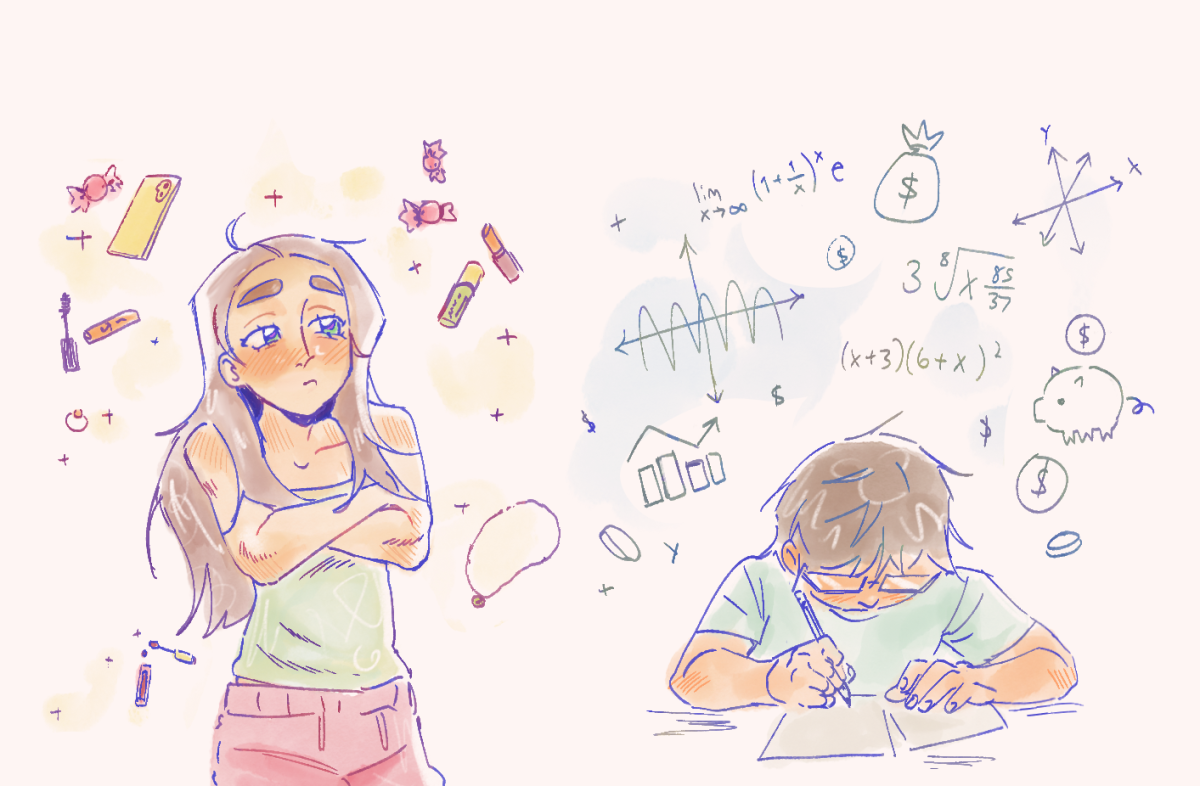

Senior Azadeh Gadeken is frustrated. Her teacher has finished lecturing, and has given the class time to do homework. Gadeken wants to be doing her work, but finds herself unable to focus. The classroom is abuzz with her peers talking and completing their own work, and the noise is too distracting. Normally, Gadeken would listen to music on her headphones to drown out the noise, but Lowell’s new phone policy, introduced at the beginning of this year, prevents her from doing so.
At the start of the school year, Lowell implemented a new Mobile Communications Device (MCD) policy that prohibits students from using their smartphones in class and the hallways. Lowell administration said that the policy was implemented to eliminate the distraction of smartphones in the classroom, but some students feel that it hinders their independence and learning.
Lowell administration introduced the first phase of the MCD policy, which banned the use of phones in classrooms, to students this August. In September, the administration introduced phase two, which banned phone and cell phone use in hallways. According to Lowell’s Assistant Principal, Abby Matthews, phase three, which began on October 14th, outlines “escalating consequences for repeated violations of the MCD policy in the classroom.” According to the policy, on the first offense, a student will receive a verbal warning. For a second offense, a written warning will be issued. An MCD will be confiscated for the remainder of the school day after a third offense, and a fourth offense will lead to a parent conference with the dean. Finally, a fifth offense will cause the phone to be confiscated and picked up by a parent again, with further action to be taken by administration.

According to Lowell’s Assistant Principal Abby Matthews, the policy was implemented to prevent students from being distracted by their phones while in class. This change in phone policy at Lowell comes after Governor Gavin Newsom of California signed the Phone-Free School Act in 2024, which required public schools to develop and implement a policy limiting the use of cellphones by July 2026. The MCD policy also follows SFUSD’s Board Policy 5.4.1. The policy prohibits phone use at school, aside from designated locations such as the cafeteria, the courtyard, and the library. If a student has a special circumstance that needs accommodating, then exceptions can be made if they have a doctor’s note, an IEP, or a 504. According to Mathews, students’ phones have too many distractions for students to have them in the classroom and maintain focus. “[Phones] make it nearly impossible for teachers to maintain focus and a learning discipline that’s required for that deeper learning critical thinking within the classroom,” Matthews said. “So the hope is that by removing this major distraction, students will be more engaged in their learning and focus on their academic pursuits.”
Matthews emphasized that she didn’t want to completely ban phones because she understood the importance of “chill time” for students during passing periods. “This policy is not about being anti-technology,” she said, “It’s really about just drawing a clear line between technology that serves a learning purpose and personal devices that are a source of constant distraction.”
Lowell is not the only high school in San Francisco to be implementing a more restrictive phone policy in recent years. According to an article published in the San Francisco Standard at the beginning of this month, several SF schools, including Thurgood Marshall Academic High School, St. Ignatius College Preparatory School, and San Francisco Waldorf High School, had done so.
Tomas Toch, director of the education policy center at Georgetown University, is a firm believer in implementing phone bans in schools. He believes that phones are detrimental to a productive social and academic environment. “[Students] pay less attention to what’s going on in class if they have [phones] and are allowed to have them in class,” Toch said. In fact, he believes that schools should implement more rigid bans for the entire school day, prohibiting students from using their phones even during passing periods. “If it’s in your pocket, you’re more likely to pull it out and look at it than you are if it’s in your locker or if it’s left at home or it’s locked in a secure location.”
Not all students believe that the phone policy is helpful. In a survey of 105 randomly selected students conducted by The Lowell in October 2025, only 16.2 percent believed that the phone policy is beneficial to Lowell students. Gadeken agreed that phones could pose difficulties to learning, and thought that limiting cell phone use in class was justifiable, but she believes the school-wide ban is unnecessary. Many of their classes already had phone restrictions that were enforced by teachers. “I wasn’t allowed to use my phone in my classes anyway,” Gadeken said, “so I don’t understand why they’re trying to enforce something that isn’t a problem here… I think that this overarching no phones in the hallways, no phones in class policy doesn’t work for anyone. I think it creates conflict between the teachers and students.”
Mary, a sophomore under a pseudonym, said that the new phone policy hadn’t changed much in her classes, either, and that she still saw students using their phones despite the policy. “People who used their phone during class before the full policy are still going to try and use their phone,” she said. Additionally, she believes that students who use their phone for entertainment instead of as a learning tool will still find a way to do that, even with the new policy. When asked, 58.1 percent of students who responded to The Lowell’s survey stated that they have used their phone in class despite the policy.

Additionally, Gadeken feels that the policy takes it too far by prohibiting the use of phones and headphones in the hallways, a decision attributed to the tendency of the school’s WiFi to be overwhelmed by mobile devices. “The hallways are not class time,” she said. “I do not have instruction, I do not have an authority figure watching me. It’s my personal time.” The Lowell administration cites Wi-Fi problems as a reason for prohibiting phone use in the hallway, but Gadeken feels that this shouldn’t be the responsibility of the students. “If they had better Wi-Fi,” she said, “that wouldn’t be a problem. It’s not our responsibility to accommodate for the school’s poor Wi-Fi. It’s their responsibility to accommodate for us.” One anonymous respondent to The Lowell’s survey said that the restriction on phone use in the hallways frustrated them because of how it impacted the time they had available to do schoolwork, which is often digital. They explained that, because they have no Wi-Fi at home, it is important to them to use as much time as possible to do this work at school, and that the new phone policy prevented them from doing so.
Students are also frustrated by what they feel is a lack of independence. Gadeken feels that Lowell has restricted student independence, and the phone ban has exacerbated the issue. “There’s almost no independence given at school in general,” Gadeken said. “So why are you trying to restrict our independence even more? Why don’t you want to teach us how to be better with things rather than just restrict us?” Meanwhile, Senior Ella Cox said that the idea of more freedom and independence was the reason she chose to go to Lowell in the first place, but that changing policies are disrupting that freedom. “I liked Lowell [because] I thought it would offer me a lot of freedom,” she said, “like freedom to choose my classes and stuff like that, and I feel like policies are just getting stricter.” She thinks that it’s important for high school kids to be able to regulate and make decisions for themselves, and that the phone policy obstructs that. “We need the ability to make our own choices as we become adults,” she said.
Many students believe that the phone ban takes away a useful educational tool. Both Cox and junior Trevor Liao have classes that require them to take photos of their work to submit, and the phone ban prevents them from being able to do so. Cox often uses her phone to check the time or the bell schedule when classroom clocks are broken or out of sight. She says the new phone policy makes it harder. “If I’m trying to check the bell schedule real quick or something—I feel like at least personally I never used my phone as a distraction during class and it only ever really helped me with tasks in class.” Instead, now that she’s not allowed to use her phone, Cox also has to use her computer instead, which she says is inconvenient because it is bulkier and takes longer.
Jennifer Moffit, an English teacher at Lowell, said that she has seen changes in her students’ behavior since the phone ban took place. She believes that constant phone use is detrimental to student learning, focus, and mental health. She is not alone: a 2024 Pew Research Study found that 72 percent of US high school teachers said cell phone distraction was a major problem in the classroom. Although she had a phone ban in place for her classroom before the school-wide came into effect, Moffitt said that the broader ban made her own restriction of phones in class easier to enforce. “I think people are more accustomed to putting them away,” she said. Additionally, Moffit said that she had noticed increased student interaction as a result of the phone ban. “I feel like there are more people who are prone to talking to each other,” she said. “In my new freshman reg, they are seated with strangers, most of them are talking to each other, some of them are doing homework on their computers, but I feel like people are talking to each other more.” Toch agrees that phones can be harmful to students’ interaction in the classroom. “It distracts students from both what a teacher is saying and it can reduce the opportunities for group work,” he explained, “[phones are] very disruptive to instruction in many classrooms.”
Some students, however, do not find themselves interacting with their peers more since the ban. Liao found that having his phone available actually increased his interaction with peers, as they could bond over games. He said that the phone ban had actually led to him interacting with his peers less. “We used to interact by playing phone games and talking to each other [about the games],” he said, “but now because the phone ban has come in we’ve not been playing these phone games and [have been] interacting with each other less.” Gadeken and Cox said the phone ban had not changed their interaction with friends, who they still communicate with on their phones in between classes. When asked in a survey conducted by The Lowell, over 60 percent of students said that the new phone policy had not changed how they interacted with their friends at school.
Lowell students also say that they are distracted by anxiety about what they are missing when they are unable to check their phones. Smart phone separation anxiety, or nomophobia, is a scientific area with developing research. In a 2022 systematic review of 52 studies, 90 percent of participants showed signs of nomophobia, with 20 percent showing mild symptoms, 50 percent showing moderate symptoms, and 20 percent showing severe symptoms. Students say that this anxiety can take away from their attention in class times. Gadeken emphasized that it wasn’t social media that made her thoughts dwell on her phone during class, but rather messages from her friends or school related stuff. “Maybe my friend in the hallway went ‘this class just got their test results posted, and in my next class, because I can’t have my phone or it’s locked up, all I can think about is those test results, which could have been fixed in a ten-second interval of me looking at my phone,” she said. It frustrates her that she is unable to perform simple actions, like checking her grades, while in class. “It’s related to school,” she said, “but I’m missing school, I’m missing learning, because I can’t stop thinking about it.”
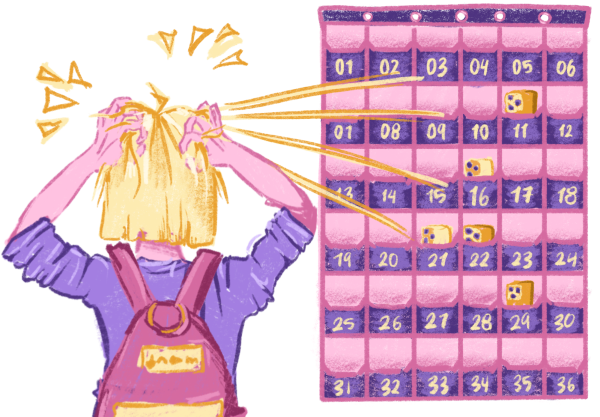
Junior Trevor Liao also expressed anxiety from being separated from his phone during class. “I feel like not having a phone makes me very claustrophobic,” Liao said, “especially when I’m in classes, because I have an urge to reach for my phone to, like, search something up. But then I can’t do that, and I feel very trapped, you know?” But in a recent survey of 105 Lowell students, 86.7 percent said that they did not experience anxiety from being away from their phone. Lowell Psychology teacher Steven Shimmon believes that, although nomophobia may be a real issue for students, it will most likely fade over time. “We would assume over time that anxiety should be reduced because there’s an idea in psychology of habituation,” he said. “We get used to changes in our environment.”
Shimmon also emphasized that being distracted in class is not a unique problem to phones—students can be distracted by anything, like doodling or wandering thoughts. Rather, it’s part of a larger issue with lack of student engagement in class. He thinks the best way to combat this divided attention is for teachers to use more engaging teaching methods. “I think that if teachers are actively engaging their students then nomophobia should not exist,” he said. “Then students shouldn’t really even be thinking about their phones because they’re engaged in whatever they’re doing.” Toch agrees that engagement is an important aspect of an academic environment. While he emphasizes the necessity of phone bans, Toch says that there are also other things that schools should do to improve student learning. For example, addressing chronic absenteeism and getting students more engaged in the classroom. To do that, he said, “you want to have students at the center of instruction.” This means putting an emphasis on student voice, perspective, and groupwork.
Looking forward, Matthews said, the Lowell administration is looking to implement further phases of the phone policy with different disciplinary actions. To do so, they are communicating and taking feedback from the Lowell Parent, Teacher, Student Association (PTSA) and the Lowell Student Association (LSA). If students have concerns about the new policy, she said, they should express them to these organizations for consideration. She wants to work with students to reduce distractions and improve the academic environment. “We’re in a learning phase together,” she said.
While the Lowell administration is doing their best to make the transition to the new policy as seamless as possible, students still have their doubts about its effectiveness in improving the social and learning environment at Lowell. They feel like it can end up interrupting and inconveniencing their learning time instead of enhancing it. “I just feel like [the phone policy] is not a good use of anyone’s time,” Cox said.