

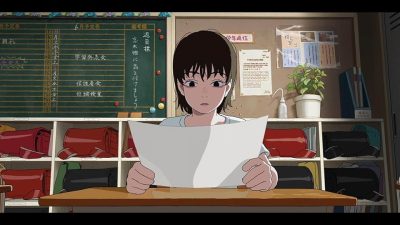
Fourth-grade girl Fujino opened her school newspaper, flipped to the page where her comic was published, and froze. The comic she had drawn was lined up with the art of another artist, named Kyomoto. Next to the beautifully shaded intricacy of Kyomoto’s art, Fujino felt that her art, which she had been proud of and which had garnered praise in the past, suddenly looked average. As students around her started to make comments that mirrored what Fujino was thinking, she reflected on all of the compliments she had received before, feeling as if she had been lied to. Her eyes went blank in denial. She said to herself, There’s no way someone in the same grade as me is better than I am at drawing.
Tatsuki Fujimoto’s 2024 film, Look Back, follows the artistic journey of two girls as they grow from elementary school students into adults. By incorporating both the characters’ love for creativity and the struggles they go through in pursuit of artistic improvement, the film acknowledges the harsh realities of creating art. With passion and practice, skills may be improved, but satisfaction is hard to reach, and somewhere along the journey, one’s love for art may be lost. The realistic portrayal of artists and their growth is what makes Look Back an incredible watch.
Through the two protagonists’ intense artistic competition, Look Back portrays the difficulty of reaching satisfaction with one’s own artistic abilities. Fujino enjoys drawing comics for her school newspaper and prizes the attention her art garners from her classmates. Initially, this hobby is not very serious, but that changes when the chronically absent student in her grade, Kyomoto, also starts publishing her art in the newspaper. Soon, the attention Fujino had once received for her art disappears. For a year, Fujino immerses herself in working to improve her art. However, as she improves, so does Kyomoto. Believing that she will never draw better than Kyomoto does, Fujino stops creating art.
The same idea of the challenges in reaching satisfaction is supported later on in the film. Fujino eventually meets Kyomoto and learns that Kyomoto struggles to communicate with others due to social anxiety. Even through these struggles, Kyomoto reveals that she is a big fan of Fujino’s art. She compliments Fujino, saying she has what Kyomoto lacks — the ability to create a story that makes the audience laugh and feel emotion. The compliment revealed that it was not only Fujino who felt incompetent in her artistic talents, but also Kyomoto. Kyomoto had subjectively better art than Fujino, but still felt that she lacked certain skills. No matter how great someone’s art may seem from an outside perspective, that does guarantee contentment for the artist.
Look Back asserts that despite challenges, the passion for art is what pushes artists to keep creating. For a couple of years, Fujino and Kyomoto collaborate on comic books and become fairly successful as an interdependent artistic pair, with Kyomoto relying on Fujino as a source of social support and confidence. However, this partnership is broken several years later when Kyomoto decides she wants to go to art school for college. When Fujino tells Kyomoto not to go to art school, and instead to stay home and continue making comics, Kyomoto says simply, “I want to get better at art.” Throughout their time together, Kyomoto relied on Fujino to create storylines for their comics, and to help her avoid anxiety-provoking social interactions. Despite Kyomoto’s fears, she is now willing to leave her source of stability and force herself to improve socially for the sake of art. To make time for art, another priority must often be sacrificed. For Fujino, that was her social life, and for Kyomoto, it was the comfort of being able to rely on Fujino. Kyomoto and Fujino show that the beauty of art lies in the artist’s dedication to their work.
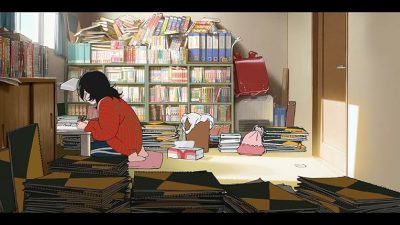
The meaning that artists gain through art can be lost if artists begin to prioritize gaining material benefits or other outcomes for their art, rather than focusing on the joys of creativity. Eventually as adults, Kyomoto leaves for art school, and Fujino continues to create comic books. But as Fujino becomes increasingly successful, she starts to prioritize validation and financial gain over the fun of art itself, and her passion for art begins to fade. After a shocking life event, Fujino looks back on an old piece she drew and asks herself why she draws. Now, the answer seems obvious to her: she draws for work, to make money. But why did she start? Why did she draw when she was younger, even in the times where she got no attention for drawing, when creating didn’t bring her any material benefit? It is often hard to have both talent and passion. When Fujino practiced in order to make money through her art, drawing became a habit — something she did for the outcome, not for the joy of the process. Without the passion that Fujino once had, art had lost its meaning.
Creativity is difficult to maintain. Look Back shows that passion, skill, and satisfaction are hard to have at the same time.