

Paige, a junior under a pseudonym, sits at her home in Glen Park waiting in anticipation, as her mom had told her that she had an exciting surprise to share. Her mom enters the room and announces some unexpected news: Paige’s family will be leaving San Francisco and moving to a house in Antioch. Paige’s heart drops and her mind races as she grapples with the prospects of this news. How could this be happening? Her mom had been discussing moving out of their rented home to a house that could accommodate Paige’s growing family at a more affordable cost, but she never imagined leaving San Francisco. Moving would mean leaving her friends, her sports team, her school community, and her life in San Francisco.
Though Paige continues to attend Lowell, which is illegal as she no longer lives in San Francisco, her everyday life is now completely altered. Her move is the result of the overwhelming cost of living in San Francisco. She, like many other Lowell students, is struggling to deal with the increasing costs of housing and daily life in the city.
San Francisco is known for its high housing prices; the average San Francisco house costs $1.4 million dollars, which is more than triple the price of the average American house. The lack of affordable housing in the city can force students and their families to move out of their homes in search of housing that they are able to afford outside of the city, defying the law if they choose to continue attending Lowell while living outside of San Francisco. This can pose a significant disruption to students’ education, social lives, and wellbeing. Meanwhile, students that stay in San Francisco are met with high rent costs and increasing prices of food, gas, and other basic necessities, which can lead to financial insecurity and, often, uncomfortable or unstable living conditions.
The high cost of living in the Bay Area makes finding affordable housing a challenge for residents, often resulting in housing insecurity and financial struggles. According to Charmaine Curtis, the principal at Curtis Development, a San Francisco-based real estate development company focusing on market-rate and affordable housing, the lack of affordable housing in the city deeply impacts low-income residents. “We have such a huge housing shortage in California. The biggest shortage is for people who are lower income,” Curtis said. In an April 2025 survey of 128 students conducted by The Lowell, 25 percent of respondents said that their family struggles to pay monthly bills sometimes or constantly. Additionally, 14 percent of respondents said that they felt anxious or uncertain about their housing stability often or all the time. “Having stable, affordable housing is really the basis for being able to have a decent life,” Curtis said. “Housing is a basic human right.”
Over half of California’s households cannot afford the cost of their homes. Tenants that cannot afford high rent prices are often pushed out by their landlords. Families who are unable to afford the cost of living in San Francisco may relocate to more affordable areas outside of the city. In order to attend San Francisco Unified School District (SFUSD) public schools, students must be residents within city limits, as stated in 3.8.7 Residency Requirement for Students of the SFUSD handbook. For some SFUSD schools, students who meet certain criteria can apply for an Interdistrict Permit, which would allow them to continue attending an SFUSD school after leaving San Francisco. However, Interdistrict Permits are not allowed for Lowell, as it is an SFUSD school with high demand and high enrollment. SFUSD schools such as Lowell often offer a greater variety of opportunities and resources than many schools in other districts, and these opportunities encourage some students to evade the law, attending SFUSD schools despite living outside of San Francisco.
In 2023, the state of California declared that San Francisco needs an additional 82,000 housing units — more than triple the city’s annual housing production average. So far, only 50,000 units have been approved. That means that the city has to plan to zone another 32,000 units to be built throughout the next 10 years, Curtis said. “At this moment in time, the problem is not a lack of a pipeline. The problem is the larger economy, interest rates, and construction costs,” she said. According to Curtis, California as a whole is short millions of housing units. A study conducted by McKinsey & Company, a global management consulting firm, found that California needs to build around 3.5 million homes by the end of the year to combat its growing population. Construction on these units has become more expensive because of inflation, which is the rate of an increase in prices over a period of time. Inflation also raises interest rates, further increasing the price of purchasing and owning a house. According to the California Housing Partnership, median rent in California has increased 40 percent since 2000, while median renter household income has increased only nine percent. Inflation and raised rent prices can leave families that are unable to pay the rent of their home struggling.
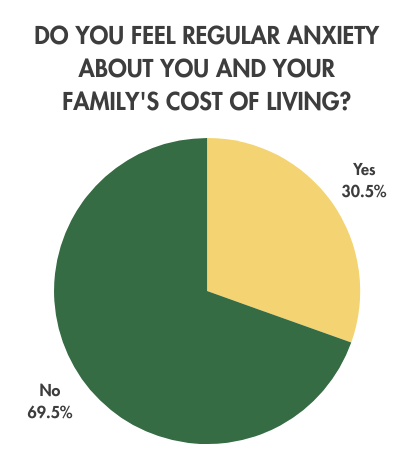
Financial instability has a wide impact, affecting students’ educations and creating prolonged distress and difficulties. According to The Lowell’s survey, 30.5 percent of respondents said that they feel regular anxiety about their and their family’s cost of living.
Ellen, a 2022 Lowell alumni under a pseudonym, recalls the constant stress of having to make sure her parents were able to pay their monthly bills. When Ellen attended Lowell, she frequently worried about mortgage payments, and had to host family members that were having financial struggles of their own. This anxiety overtook her mind, and the inability to focus in class resulted in her doing poorly on tests. “There’d be times in classes where I just wasn’t totally there,” she said. “It added unnecessary stress when I should be prioritizing my education, because that was my number one job.”

Makenna, a junior under a pseudonym and a resident of an affordable housing complex in the Fillmore district, notices the rising cost of living all around her. According to Makenna, recent changes in her neighborhood, like the closing of the local Safeway and an increase in high-priced stores, cause her to worry that she may be displaced by an increased cost of rent and other necessities in her neighborhood. In addition to the damage that she believes these price increases are causing to her community, Makenna also fears for her family’s own financial stability. Her building needs significant repairs, which will raise the cost of monthly maintenance they pay. Makenna’s family relies solely on her mother’s income, as her grandmother recently stopped receiving retirement checks. The rise in rent may force them out of the building entirely. “It makes me feel really anxious for my future, my financial stability, how I will be able to survive once I’m on my own, how my family will do,” Makenna said. “I’ve definitely cried about it multiple times. It brings me a lot of worry.”
Senior Ilya Shuster’s family must vacate their current home by the end of June. The owner of Shuster’s home presented his family with an impossible choice: moving out of the space, or buying it. Shuster’s family, like many other San Francisco residents, cannot afford the cost of purchasing the house. “The mortgage and down payment is a crazy amount of money that, even if we tried some alternatives, we can’t even get close to affording,” Shuster said. This is his fourth time moving because of high rent, but Shuster feels that this instance is more significant than the rest. He’s been in his current home since sixth grade, and losing it means leaving behind a big part of his adolescence. According to Shuster, he would like to revisit his past homes in the future and be able to reminisce on his formative years, but due to his frequent relocation, he is unable to return to the homes he once lived in. “I feel sad that I’m never going to see those places again,” Shuster said. Like Shuster, Paige frequently moves and feels that she struggles to make memories in the various houses that she has lived in. “Some of my friends tell me about the houses they’ve lived in since they were kids, and the memories they have there,” Paige said. “It’s pretty rough moving every year. I don’t remember the last time I had memories in a house.”
Atticus, a junior under a pseudonym, moved to a house in Vallejo at the beginning of the school year. His family needed more space, and wanted to buy a house amid rising rent costs. Atticus debated going to school in Vallejo, but the nearby school was small and, he felt, limiting, only offering five AP courses, little access to jobs and internships, and a largely non-competitive environment. These conditions were the opposite of the aspects of Lowell that Atticus values. “There’s not a lot of opportunities for anything. At Lowell, you can find resources for internships, jobs, everything,” Atticus said. For Paige, Lowell is where her community is, and uprooting her entire education and social life, as well as her athletics, in her junior year of high school would have presented a significant personal challenge.

Atticus’ family initially searched for housing within the city, but had difficulty finding a house they could afford in addition to the high cost of daily living in San Francisco. Atticus feels that his family is significantly affected by the recent increase in food and gas prices, which have been highly impacted by inflation. “Those types of expenses, concurrent and just happening every single month, are really easy to notice how they increase over time,” Atticus said. These expenses, coupled with the tuition his family pays for his sister’s education, place a financial strain on his family.
Paige’s education and social life suffer under the living conditions she experiences. Her daily commute to school takes two hours on the Bay Area Rapid Transit (BART) train, causing her to frequently miss her first two classes of the day. “My grades dropped a lot because I can’t make it to first period, or I can’t make it to second period, at all,” she said. “I’m not doing too good in my first two classes, because the commute is just so long.” Paige’s younger siblings have also been detrimentally impacted by the family’s distance from San Francisco, missing days of school as Paige’s mother struggles to afford the gas required for the daily commute from Antioch to San Francisco and back. Additionally, Paige’s commute adds strain to her extracurriculars and social life. Being on a sports team, practice times go late into the evening, past the point when her mother is able to pick her up. According to Paige, she is only able to begin her schoolwork after completing her sport practice and her two hour commute home on BART, negatively impacting her schoolwork and sleep. Paige’s desire to spend time with friends is also impacted by her lengthy journey, as she must plan well in advance. Prom, for example, is an event where Paige’s long commute conflicts with her wish to attend school activities and social gatherings. If Paige were to use BART to travel to prom and back, she would need to take BART late at night, and would not return home until around one in the morning. Sometimes, Paige said, she chooses to stay at home rather than make the effort of commuting to San Francisco for social activities.
Students dealing with housing insecurity often feel alienated from their peers. This topic is something students can be unwilling to discuss with others, and some feel that they negatively compare themselves to peers in more comfortable living situations. “It’s definitely something that makes me uncomfortable because it’s not a fun experience, and you never want to talk about the bad things that happen to you,” Shuster says. He feels that most of his peers either own their house or don’t have to constantly move houses. Junior Evelina Temple has a similar outlook. “I always catch myself comparing myself to other people that have houses or bigger bedrooms, who are not worrying about how they’re going to pay for rent,” she said. This comparison can create further distress in an already isolating situation.
There are not enough affordable housing units in San Francisco. According to Curtis, the city’s housing and zoning department is pushing to build tall and dense apartments in low-density neighborhoods. However, Curtis said, this is harder than it sounds. She said that the current economic crisis in America, coupled with an anti-affordable housing movement, is slowing the development of additional housing construction in San Francisco, as well as the passage of laws that would allow this construction. NIMBY, or “not in my backyard”, is a term commonly associated with wealthier individuals who are resistant to new construction in their neighborhoods, particularly high-density affordable housing. Although proponents of high-density affordable housing claim that this construction often benefits homeless or otherwise under-privileged people, NIMBYs see the addition of new housing units as a disruption to their communities, and often campaign against them.

Despite pushback from some San Francisco residents, there are also pro-affordable housing movements forming in the city, Curtis said. The “yes in my backyard,” or YIMBY, movement is one of these forces. YIMBYs advocate for more affordable housing in wealthier neighborhoods, claiming that higher density buildings can provide homes in the city for San Franciscans that need affordable housing. Rezoning laws in the city are constantly changing to encourage the construction of more affordable buildings, Curtis said. “A lot of what this rezoning is doing is raising height limits and taking away density limits. Instead of saying you can build one unit per 400 square foot of lot area, it’s saying you can build as many units as you can fit in this building.”

The only way to end the affordable housing crisis in San Francisco is to build more affordable housing units, Curtis said, but this won’t be easy. The construction of these units would require immense amounts of money and resources, as well as cooperation from San Francisco residents. San Francisco is implementing policies that make this construction easier, such as Governor Brown’s Streamline Affordable Housing Proposal, which aims to accelerate the permitting process for certain projects. Permitting is the stage of construction when building plans are approved, and this step must be completed before construction begins. According to The Bay Area Council Economic Institute, an additional 6,224 units could be constructed if permitting times were reduced by one-third, and this would decrease the cost of these units by nearly six percent. Additionally, Proposition C, passed in 2012, authorized the creation of a San Francisco Housing Trust Fund consisting of millions of dollars set aside for affordable housing creation and preservation. According to the Housing Trust Fund Five Year Report from 2018-2023, the program has provided over 150 million dollars for affordable housing development, down payment assistance loans, housing stabilization programs, and more. Curtis believes that various sectors of construction and development must collaborate in order to build the affordable housing that San Francisco currently lacks. “We need more private developers building affordable housing,” Curtis said. “We need the government supporting more housing financially and through rules and regulations. Basically, we need all hands on deck.”

Lowell students who aren’t able to afford adequate and affordable housing in the city face severe disruption to their livelihoods and education. Students who experience housing instability or difficulty affording the cost of living often feel anxious and uncertain about these issues. However, many still have hope for a future in San Francisco, amidst their financial insecurity. Shuster loves San Francisco, even though its high prices have made living here more difficult. “When I have a stable income to support myself, I’d like to move back to San Francisco,” Shuster said. “There’s places that I have fond memories attached to, and I would like to stay here for the rest of my life.”