
After an upsetting breakup with her boyfriend, Lia, a sophomore under a pseudonym, went to his sports practice to humiliate him in front of his friends and teammates. Feeling confused and distraught because of the relationship ending, she had hoped that doing this would help provide her closure. This was unlike Lia’s normal approach to relationships; normally, she would have texted her ex-boyfriend and dealt with the situation between the two of them. However, Lia was influenced by a TikTok video she saw while she was still in the relationship. The video featured a girl unexpectedly showing up at her ex-boyfriend’s sports practice to embarrass him by yelling at him in front of his teammates. Lia, being in a relationship at the time, was shocked by this content and could not imagine herself in the same situation as this girl. However, she found herself acting almost identically to the girl in the video after she broke up with her boyfriend. And, ultimately, she ended up feeling worse instead of better.

This experience is not unique to Lia. Many Lowell students have been negatively impacted by the relationship advice and content they consume online. This online advice ranges from how to approach your crush to how to reach unattainable physical goals in order to attract a partner. As a result, students often develop warped perceptions of real-life relationships, which can make them feel too inadequate to be in a relationship, damage an existing one or ruin it altogether in addition to impairing a student’s self esteem and confidence.
Lowell students often see relationship advice online. The majority of it comes from social media platforms such as TikTok and Instagram; 84 percent of respondents reported that they see relationship advice on TikTok, and 71.5 percent see it on Instagram, according to an April 2025 survey of 161 students conducted by The Lowell. Some students find that even though they might not believe the relationship advice they see online at first, the advice sticks with them, and they unintentionally apply it to their own lives. “I remembered the video [giving relationship advice] and thought to do the same thing,” Lia said. “The advice has stuck, even though it wasn’t good.”
According to Elisabeth Schriber, a licensed marriage and family therapist, most online relationship content advice is not from therapists or other relationship specialists. “Postings on TikTok mostly appear to be expert advice, but a lot of it is really pseudoscience,” she said. “It’s mostly from people who are not trained.” Furthermore, Dr. Fleur Gabriel, who does research in areas of youth media and cultural studies at Federation University, explains that most creators give advice that is unprofessional and heavily influenced by their own experiences. It is also delivered in a short-form format that teens find desirable. As a result, they are at a higher risk of being exposed to untrustworthy information about relationships, according to Gabriel. “The risk here – what teens are ‘vulnerable’ to – is accessing fringe or extremist content or content that promotes dangerous, abusive, or dysfunctional conduct in relationships,” Gabriel said.
In an April 2025 survey of 161 students conducted by The Lowell, 64.7 percent of respondents said that they do not feel attractive enough to date because of relationship content they’ve seen online regarding physical appearance. Corey, a sophomore under a pseudonym, feels that many online relationship trends propagate unrealistic beauty standards, and this content is consumed by vulnerable teens who are already insecure. “The expectation that you have to be extremely physically desirable to be in a relationship is something that’s been around for a while, and it has been exacerbated by social media,” Corey said. Kristen, a junior under a pseudonym, perceives most of the people in relationships she sees on her Instagram Reels as being conventionally attractive. Constantly seeing these couples causes her to feel insecure about her own appearance and relationship prospects. “I’ll see all these beautiful people being like, ‘this is how to get in a relationship,’ and I’ll be like, ‘I can never do that,’” Kristen said.
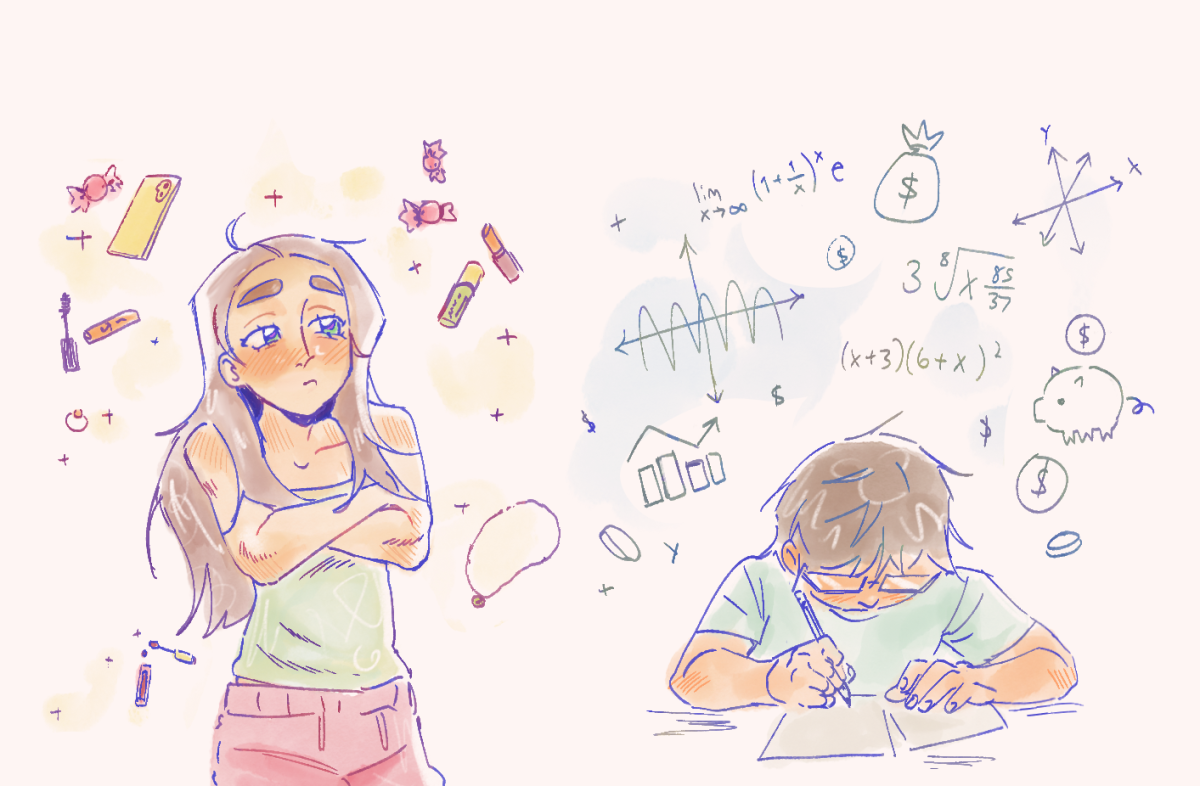
Content regarding relationships on social media is often exaggerated for entertainment value and not reflective of a real-world relationship. Additionally, content is often very curated, showcasing an idealized version of someone’s relationship. “Somebody who wants to tell the world about how great their boyfriend is isn’t going to show some petty fight about something, they’re gonna show the grandiosity [of the relationship],” Schriber said. Due to the prevalence of these idealized relationships on the internet, some Lowell students find themselves overthinking their own personal relationships. “I think that relationships are definitely overcomplicated now due to social media and the feeling of the need to perform,” Kristen said. “Relationships were a lot more simple when my parents were in high school.” There is often a large focus placed on material gifts in online relationship videos. Many videos show one partner — usually the boyfriend — constantly buying expensive things for their significant other. According to Lia, this is an economically unattainable way for most teenagers to treat their significant other in a high school relationship.
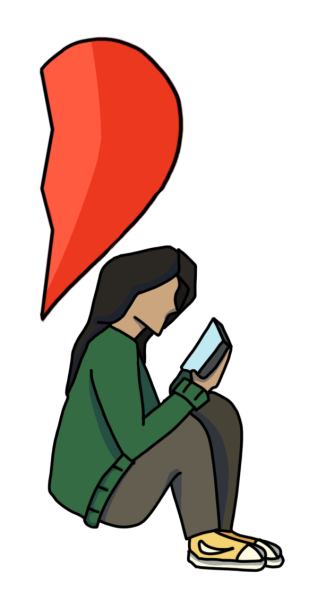
Some content can instill anxiety and make students feel insecure in their relationship. For example, online relationship advice often tells viewers that they deserve constant attention from their partner. For some students, this leads them to stress about how often their partner stays in touch with them throughout the day. Lia found herself seeing this type of content often on her TikTok page. “‘If your boyfriend doesn’t text you 24/7, he probably doesn’t love you as much’,” Lia said. She believes that this can cause students to assume that when a relationship gets more comfortable and communication is not as persistent, this lack of constant texting means that the relationship will end. “It definitely causes fear,” she said.
One issue with seeking advice on the internet is that many posts are overly simplistic, causing some viewers to develop a shallow or false idea of relationships. Lia reported that the online advice regarding relationships she sees on a daily basis often categorizes a person’s actions as good or bad using labels with harsh connotations, such as “toxic,” when in reality, these are behaviors that couples can work past. She feels that this labeling encourages people to break up with their partner if their partner falls into these categories. Lia recalls seeing advice sharing statements like, “If your boyfriend does this, he’s toxic, if your relationship does this, it’s toxic.” This causes many teenagers to believe that all relationships should look and behave a certain way. However, applying such generalizations to real life relationships can be harmful, as no person is the same. “Generalizations can be really dangerous, especially when you’re talking about emotional connection that matters a lot to you,” Luke, a senior under a pseudonym, said.
For teen boys, social media often promotes hypermasculinity in relationships. Content creators promote traditionally masculine stereotypes, such as having the male partner be the breadwinner of the relationship and being very physically strong. Corey believes that this creates unrealistic standards for teen boys and makes them feel that, without having these attributes, they are undesirable. These creators are often grown men targeting young teen boys. “I’m comparing myself to 28-year-olds with tech jobs and a [gym] membership, so I would say that these trends started by adults can seep into the target audience for Instagram and stuff like that, which [I believe] is children,” Corey said.
While teens will continue to see relationship advice online, many are beginning to avoid it, instead attempting to seek advice from more reliable sources. Luke finds relationship content online to be biased, revolving around the content creator’s own experiences. Now, he finds himself consuming relationship content more cautiously, or turning to experts when seeking relationship advice from the internet. “Listen to somebody whose profession it is to deal with dating advice, like a relationship counselor or a relationship therapist, or somebody who has done a [large] amount of research,” Luke said. Gabriel said that students should prioritize finding reliable sources for online advice. “Ensuring teens have strong community connection and support — including in the online space — as well as good media and critical information literacy are ways we can support teens in developing healthy relationship habits,” Gabriel said. Furthermore, recognizing that social media is a highly curated version of someone’s life can help prevent teens from forming false perceptions of other people’s lives. “Real life is a range of different experiences,” Schriber said. Corey encourages students to look beyond the aspects that relationship advice emphasizes, such as physical attractiveness, when thinking about their own high school relationships. “Value who the person is in reality, as opposed to superficial attributes,” Corey said.